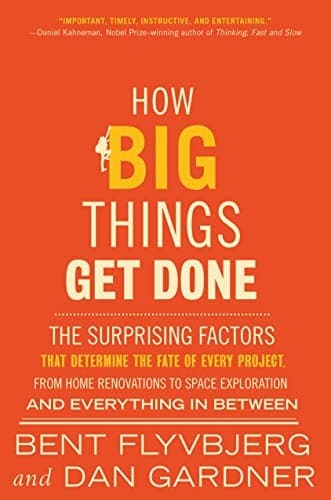
How Big Things Get Done
Bent Flyvbjerg and Dan Gardner
Flyvbjerg built the largest empirical database of project outcomes ever assembled (16,000-plus projects) and found only 8.5% hit both cost and schedule. His answer is a single inversion: think slow, act fast, and find your smallest repeatable unit. Book 3's Chapter 1 borrows this directly: the goal isn't too big, the first brick is undefined.
Buy on AmazonAs an Amazon Associate I earn from qualifying purchases.
Referenced in
Frameworks on this site from How Big Things Get Done
Ch 1 · The Momentum Playbook
Plan Slow, Start Small
Think once, in full, up front. Then make the daily ask tiny.
Primary source: Bent Flyvbjerg and Dan Gardner, How Big Things Get Done.
Ch 1 · The Momentum Playbook
The Repeatable Brick
Build in repeatable units that allow learning to compound.
Primary source: Bent Flyvbjerg and Dan Gardner, How Big Things Get Done.
More like this
Already read it?
Now install it.
Knowing a principle and installing one are two different operations. Get The Achievement Blueprint free, then one framework a week, every Tuesday.
Free. No spam. Unsubscribe anytime.