Dip or Dead End
The Promise
Every hard stretch feels identical from the inside. Learn to tell the ones worth pushing through from the ones worth abandoning today.
How It Works
- Name the terrain before you decide. When a pursuit turns hard, ask: is this a Dip (temporary, leads somewhere) or a Dead End (permanent, leads nowhere)? The feeling of difficulty is identical; the trajectory is not.
- Quit the Dead Ends immediately. Every hour grinding on a dead end is an hour stolen from a Dip you could be crossing. Quit those today and reallocate the hours.
- Lean into the Dip you chose. Once you've confirmed a stretch leads somewhere worth having, the difficulty is the point. The scarcity of people willing to cross it is exactly what makes the far side valuable.
In Practice
Worthwhile pursuits share a shape: an exciting start, then a long hard slog before mastery. That slog is the Dip, the stretch where the thrill is gone, the payoff is far off, and most people quit. The Dip is the moat that keeps the reward scarce; crossing it is what creates the value. The skill that matters here is diagnosis. Winners quit fast and often, but they quit the right things, the Dead Ends, so they can pour everything into crossing the Dips.
Source book
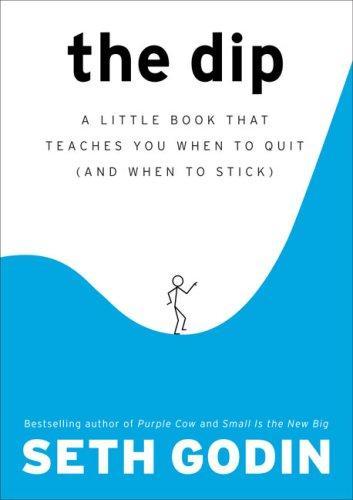
Primary source: Seth Godin, The Dip.

Reading is the easy part
Install it, don’t just read it.
Dip or Dead End is walked from principle to practice in The Momentum Playbook. Get The Achievement Blueprint free, then one framework a week, every Tuesday.
Free. No spam. Unsubscribe anytime.
The journal runs this framework in The week's Notes page. See the journal
Keep going
Ch 2 · The Identity Install
Behavior Follows Identity
Claim the identity first; the behavior reorganizes around it.
Primary source: James Clear, Atomic Habits.
Ch 2 · The Momentum Playbook
Commit, Act, Earn
Commit before you feel ready. Confidence arrives as the receipt.
Primary source: Dan Sullivan, The 4 C's Formula.