Commit, Act, Earn
The Promise
Growth runs in a fixed order: commit, act, earn. Waiting to feel ready gets the order backwards, because the readiness only arrives after you move.
How It Works
- Commit before you're ready. Make the decision at the point of maximum uncertainty, not after the fog clears. A decision made after the fear resolves is just a confirmation.
- Act through the fear commitment produces. The discomfort confirms you committed to something real. Read it as your position in the sequence, not proof you chose wrong.
- Earn capability in motion. New skill comes from doing the committed thing under pressure. You cannot pre-load it from the sidelines.
- Read hesitation as a location, not a verdict. Ask "which stage am I in?" rather than "should I stop?" Stopping at Act just returns you to Commit, where the same fear waits unchanged.
- Treat confidence as output, never input. A commitment too small to generate fear was probably too small to matter.
In Practice
The order gets run backwards everywhere: confidence treated as the entry fee, commitment postponed until it shows up. Sequenced right, fear stops being a stop sign and becomes the expected middle of the process.
Dan Sullivan's 4 C's Formula maps the same growth sequence as four stages ending in confidence. This card departs from it on one point. Sullivan makes confidence the fourth stage, and a stage is somewhere you can stand and wait. Better to treat it as the receipt the first three moves hand you. Bank it, then spend it on a bigger commitment.
Source book
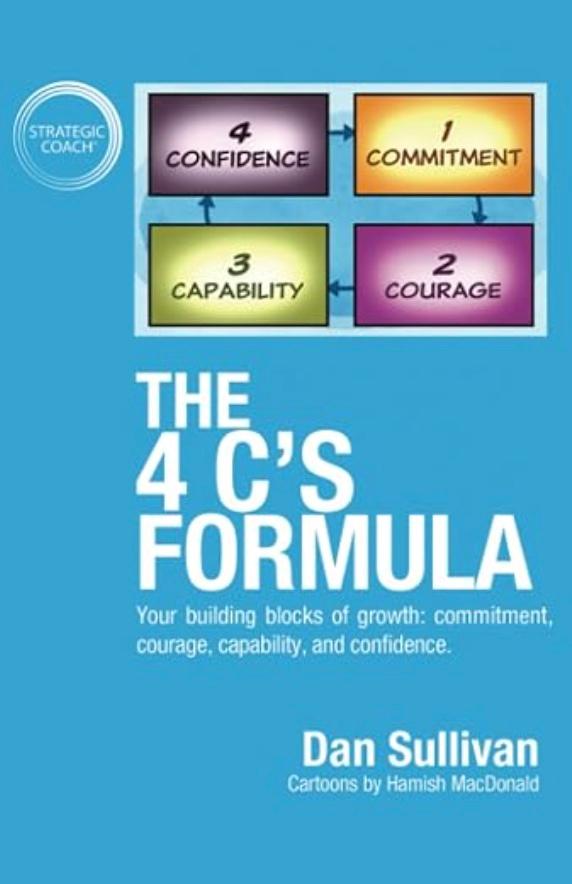
Primary source: Dan Sullivan, The 4 C's Formula.
Reading is the easy part
Install it, don’t just read it.
Commit, Act, Earn is walked from principle to practice in The Momentum Playbook. Get The Achievement Blueprint free, then one framework a week, every Tuesday.
Free. No spam. Unsubscribe anytime.
Keep going
Ch 2 · The Identity Install
Behavior Follows Identity
Claim the identity first; the behavior reorganizes around it.
Primary source: James Clear, Atomic Habits.
Ch 8 · The Momentum Playbook
Dip or Dead End
This hard stretch: the Dip before the payoff, or a dead end?
Primary source: Seth Godin, The Dip.